
At a Glance
- 70,000+ articles migrated across 10 years of content with zero data loss and zero SEO degradation
- 10,000 daily visitors served reliably with architecture built for traffic spikes during breaking news
- Full server rebuild on DigitalOcean with AWS CloudFront CDN and Nginx reverse-proxy configuration
- Two staff members are trained to fully manage and operate the platform independently after handoff
- Second engagement — I built their first WordPress platform 8 years prior; they came back when they needed to scale again
The Challenge
Hibr Press is one of the most prominent independent Syrian newspapers operating in exile. A decade of continuous publishing had produced over 70,000 articles — a significant body of journalistic work representing years of reporting that simply cannot be lost, corrupted, or degraded in a migration.
The problem wasn’t a single failure. It was accumulated technical debt reaching a breaking point.
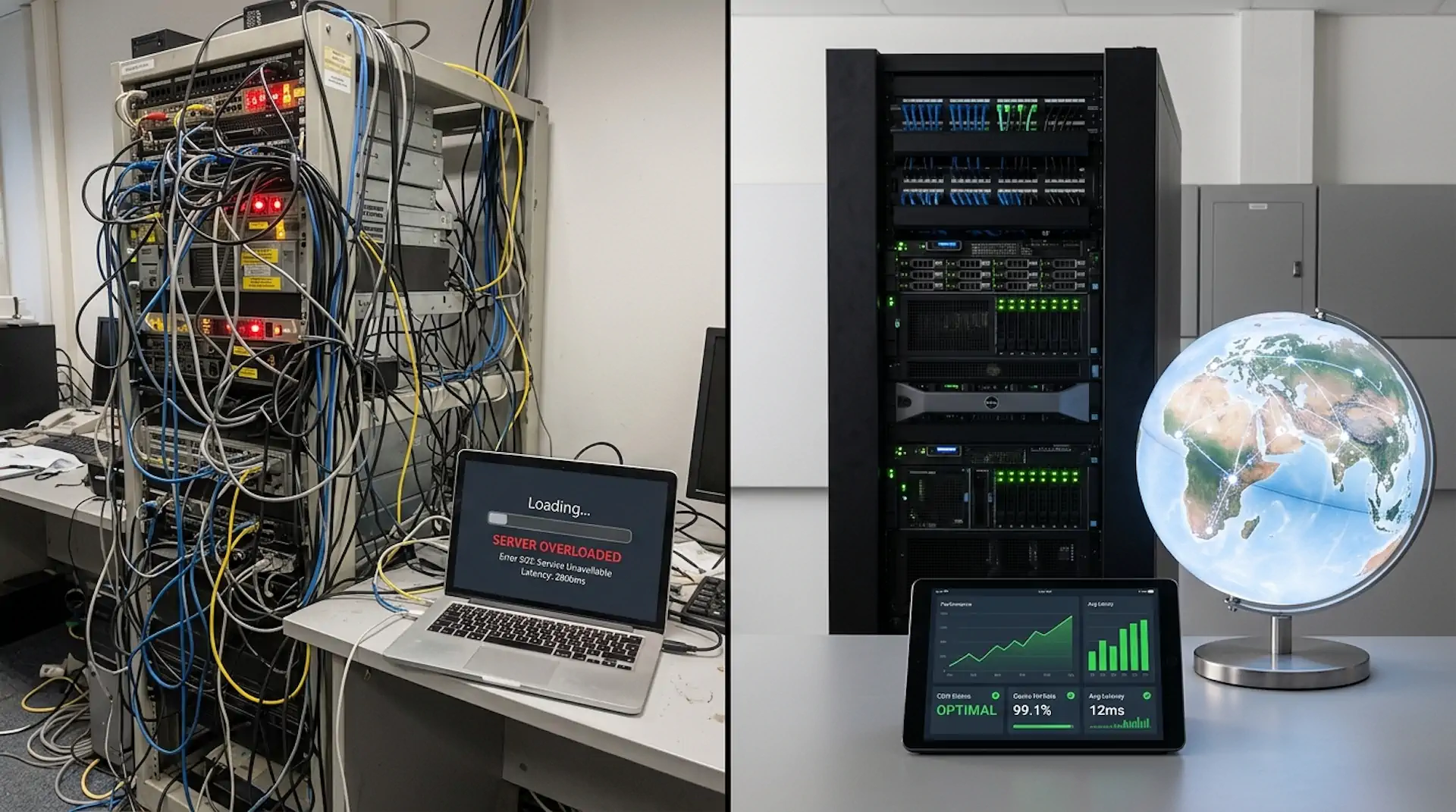
The original infrastructure was no longer fit for purpose. The site was running on an aging WordPress installation with an outdated theme and a plugin stack that had grown organically over years — each plugin added to solve a problem, none ever removed, all of them adding weight to a platform that was already struggling. Page load times were unacceptable for a news operation where readers expect instant access, especially during breaking stories when traffic spikes suddenly and without warning.
10,000 daily visitors is not a small number. For a news platform serving a politically engaged diaspora audience, that traffic is not evenly distributed. A breaking story — an election, a military development, a significant political event — can multiply concurrent visitors in minutes. An infrastructure that performs adequately under normal load can collapse entirely under that kind of spike. For a news organization, that collapse is not just a technical inconvenience. It is a reputational failure at exactly the moment visibility matters most.
The migration risk was severe. Moving 70,000 articles, years of media files, category structures, author records, and metadata from one architecture to another — without losing a single piece of content, without breaking existing URLs that had accumulated years of search equity, and without taking the site offline during the process — is not a standard migration. It is a precision engineering operation.
The Approach
The first decision was architectural: what kind of server environment does a high-traffic Arabic-language news platform actually need, and what does it not need.
A shared hosting environment was immediately ruled out — the traffic profile and spike behavior required dedicated infrastructure with direct control over server configuration. A managed WordPress hosting platform would have introduced cost and constraint without delivering the performance ceiling this operation needed.
The right foundation was a DigitalOcean dedicated server — giving full control over the environment — fronted by AWS CloudFront as the CDN layer, and with Nginx configured as a reverse proxy sitting in front of the WordPress application. This architecture separates concerns cleanly: CloudFront absorbs static asset delivery and distributes it globally close to readers, Nginx handles request routing and provides the first layer of traffic management and protection, and the WordPress application only processes what actually needs to reach it. The result is a stack that can absorb a breaking news traffic spike without the origin server ever seeing the full load.
For the CMS layer, I made a deliberate decision to avoid heavy relational plugins. A news publishing operation needs speed and simplicity at the content layer — editors publishing under deadline cannot be slowed down by complex admin interfaces. I deployed and configured the Publisher theme with WordPress structured for high-volume rapid publishing, keeping the plugin footprint lean and every unnecessary dependency removed.
What I Built
Legacy Data Migration — 70,000 Articles Engineered the full extraction and migration of a decade of journalistic content from the old database into the new architecture. Every article, every media attachment, every category assignment, every author record, and every internal link was migrated intact. URL structures were preserved in full to protect the site’s accumulated search equity — a news organization that loses its SEO history loses the discoverability of its entire archive. Zero content was lost. Zero URLs were broken.
DigitalOcean Server Configuration Provisioned and hardened the dedicated server environment from scratch — operating system configuration, security hardening, firewall rules, resource allocation tuned for WordPress performance under sustained traffic load, and server-level caching to minimize database queries on high-traffic pages.
Nginx Reverse-Proxy Layer Configured Nginx as a reverse proxy in front of the WordPress application — handling request routing, implementing rate limiting to blunt the impact of traffic spikes and hostile request patterns, and providing gzip compression to reduce payload sizes before content reaches the reader. This layer means the application server is never directly exposed to raw traffic volume.
AWS CloudFront CDN Integration Integrated AWS CloudFront as the global content delivery layer. Static assets — images, stylesheets, scripts, cached pages — are served from edge locations close to readers worldwide, dramatically reducing latency for an audience distributed across the Arab diaspora. Dynamic content requests that require the origin server pass through correctly; everything that doesn’t is served from the edge.
Lean CMS Deployment Deployed and configured the Publisher theme as a high-performance news publishing environment. The plugin stack was stripped to essentials only — no legacy dependencies, no redundant tools, nothing that adds weight without adding function. The result is an admin interface that editors can operate quickly under the pressure of a breaking news cycle.
Staff Training & Independent Handoff Trained two of the organization’s employees to fully manage the platform — server monitoring, content operations, routine maintenance, and basic incident response. The goal was complete operational independence. They have not needed me since handoff.
The Outcome
A decade of journalism is now on infrastructure capable of actually supporting it. The 70,000-article archive loads fast, ranks correctly in search, and is no longer at risk from the architectural fragility that had been accumulating for years.
For daily operations, the difference is immediate. Editors publish faster. Pages load faster. The platform behaves like a professional news operation rather than a personal blog that scaled beyond its original design.
The infrastructure’s real test is breaking news. When traffic spikes — and for a Syrian news organization covering an active geopolitical situation, it spikes regularly — the CDN absorbs the surge at the edge, the reverse proxy manages the request load, and the origin server continues serving the application without degradation. The site stays up. The story gets read.
The fact that they came back to me eight years after I built their first platform is the most direct measure of the relationship. The fact that they now operate entirely independently is the most direct measure of the work.
My Role & Responsibilities
I designed and executed the full infrastructure rebuild — server provisioning, CDN integration, reverse-proxy configuration, database migration, CMS deployment, and performance optimization. I managed the complete migration of 70,000 articles without data loss or service interruption, and delivered the platform with full staff training for independent operation.