
At a Glance
- No generic legal SaaS — the CRM, client portal, and case management are built custom, engineered around how the firm actually operates, rather than adapted from an off-the-shelf product
- Full-cycle legal CRM — inquiry capture, case tracking, assigned attorney management, financials, and employee records in one system
- Client self-service portal — every client has a personal account to monitor their case status and financial records
- 3 active languages — Arabic, English, and Turkish live; Farsi and Russian in planning
- Ongoing technical partnership — I operate as the firm’s dedicated technical arm, not a one-off vendor
The Challenge
Şura Hukuk is a prominent law firm operating in Türkiye and serving an international client base across multiple languages and jurisdictions. When I came on board, the firm’s digital operation was essentially nonexistent as infrastructure.
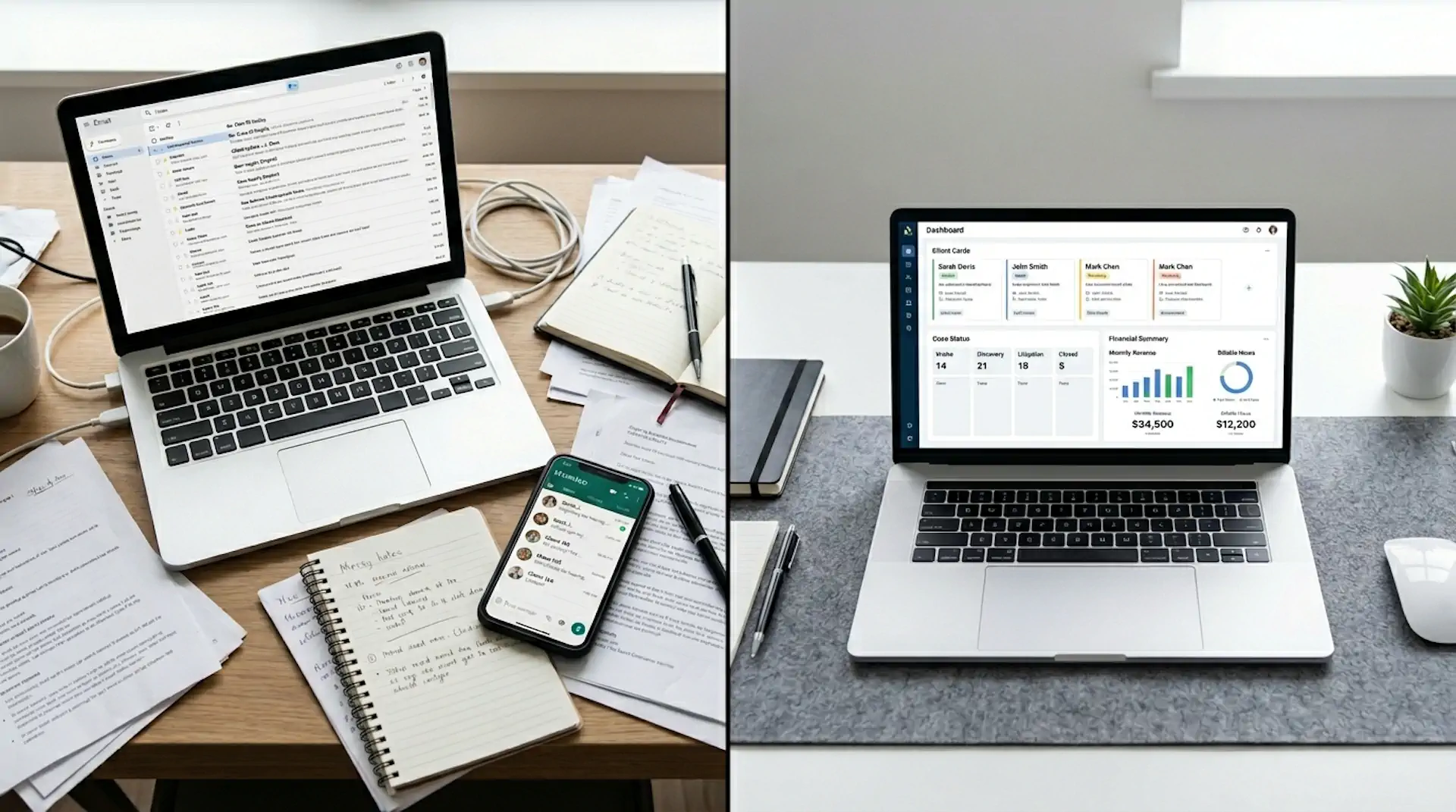
Inquiries arrived through informal channels — WhatsApp, email, word of mouth — and were handled however the receiving attorney decided to handle them. There was no intake process, no tracking, no assignment logic. High-value leads from international clients arrived in the same unstructured way as everything else, and there was no system to ensure they were followed up on appropriately or at all.
Internally, the firm had no operational visibility. There was no way for management to see how many active cases were in progress, what stage each case was at, which attorney owned it, or what the firm’s financial position looked like across its client base. That information lived in individual attorneys’ heads and personal inboxes.
Clients had no visibility either. Once a client engaged the firm, they had no formal channel to check the status of their case, see what had been done on their behalf, or understand their financial obligations and payment history. All of that happened through informal communication — which is exactly the kind of opacity that erodes trust in a legal context.
The multilingual dimension made everything harder. Serving Arabic, English, and Turkish-speaking clients simultaneously meant that every informal system broke down faster — the wrong language, the wrong attorney, the wrong routing. There was no infrastructure capable of handling that complexity without manual intervention at every step.
The firm needed more than a website. They needed an operational backbone.
The Approach
The instinctive answer for a legal firm needing case management is to buy a legal SaaS product. I rejected that approach immediately, for two reasons.
First, generic legal CRM platforms are built for common-denominator law firm structures — they carry years of features this firm would never use, impose workflows that don’t reflect how the firm actually operates, and come with ongoing subscription costs that compound indefinitely. Second, and more importantly, a firm handling sensitive multilingual legal matters across international jurisdictions needs complete control over where its client data lives and how it is accessed. A third-party SaaS platform introduces a dependency and a data exposure risk that is unacceptable in this context.
The right answer was a purpose-built platform — engineered specifically for how Şura Hukuk operates, owned entirely by the firm, and built on infrastructure I could maintain and extend as the firm grows.
I designed the full system before building anything: the data model for clients, cases, attorneys, financial records, and employees; the permission architecture separating client-facing views from internal management; the multilingual routing logic; and the lead capture and intake flow from first contact through case assignment.
What I Built
Custom Legal CRM — Natively Inside WordPress Built a complete case and client management system using ACF Pro and custom PHP, engineered directly into the firm’s WordPress backend. The CRM tracks the full client lifecycle: initial inquiry, intake assessment, case creation, attorney assignment, case stage progression, and closure. Every record is structured, searchable, and accessible only to authorized users. No data leaves the firm’s own server.
Client Self-Service Portal Every client of the firm has a personal account. From their portal they can log in and see the current status of their case, review what actions have been taken, track their financial obligations, and see their payment history. This replaced the informal back-and-forth that previously served this function — and in doing so, significantly raised the firm’s perceived professionalism with international clients who expect this level of transparency as standard.
Financial Management Layer The platform tracks the financial relationship between the firm and each client — retainer agreements, invoiced amounts, payments received, and outstanding balances. Management can see the firm’s financial position across its entire client base at any time without assembling that information manually.
Employee & Attorney Management Internal records for the firm’s attorneys and staff — case assignments, workload visibility, and operational records — are managed within the same platform. Management has a single environment for both client-facing and internal operational data.
Multilingual Lead Capture & Routing The public-facing website is fully multilingual across Arabic, English, and Turkish, with Farsi and Russian in active planning. Lead capture forms are language-aware — an inquiry submitted in Arabic routes differently than one submitted in English, ensuring the right attorney receives it from the first contact. Tawk.to live chat is integrated into the site and configured to notify available attorneys in real time when a high-intent inquiry comes in.
Full Brand & Digital Presence I executed the firm’s complete digital launch from zero — UI/UX design, visual identity, copywriting in all three languages, and social media profile architecture built to project legal authority to an international audience.
Ongoing Technical Operations I operate as the firm’s dedicated technical partner on a continuous basis — managing server maintenance, system updates, content operations, and platform evolution. The legal team has no technical overhead. Their digital infrastructure simply works, and when it needs to change, I change it.
The Outcome
The firm went from no operational infrastructure to a complete, integrated legal operations platform in a single engagement. Every informal process that previously depended on individual attorneys managing their own inboxes and communications is now tracked, structured, and visible to management.
Internationally, the impact was immediate. Clients from Arabic-speaking markets and English-speaking jurisdictions who previously had no formal way to engage the firm now land on a multilingual platform that speaks their language, captures their inquiry correctly, and gives them a client portal that meets the standard they expect from a professional legal partner.
The absence of SaaS dependency is worth noting specifically. The firm pays no recurring platform fees. Their client data sits on their own infrastructure. And because I own the architecture, every feature added to the platform is built to their exact specification — not constrained by what a third-party product permits.
Two years in, I am still the firm’s technical partner. The platform has grown with the firm, and that relationship shows no sign of changing.
My Role & Responsibilities
I designed and built every component of this platform and continue to operate it. This is not a completed project — it is an active, ongoing technical partnership covering platform development, server operations, content management, and digital strategy. I am the firm’s entire technical department.