
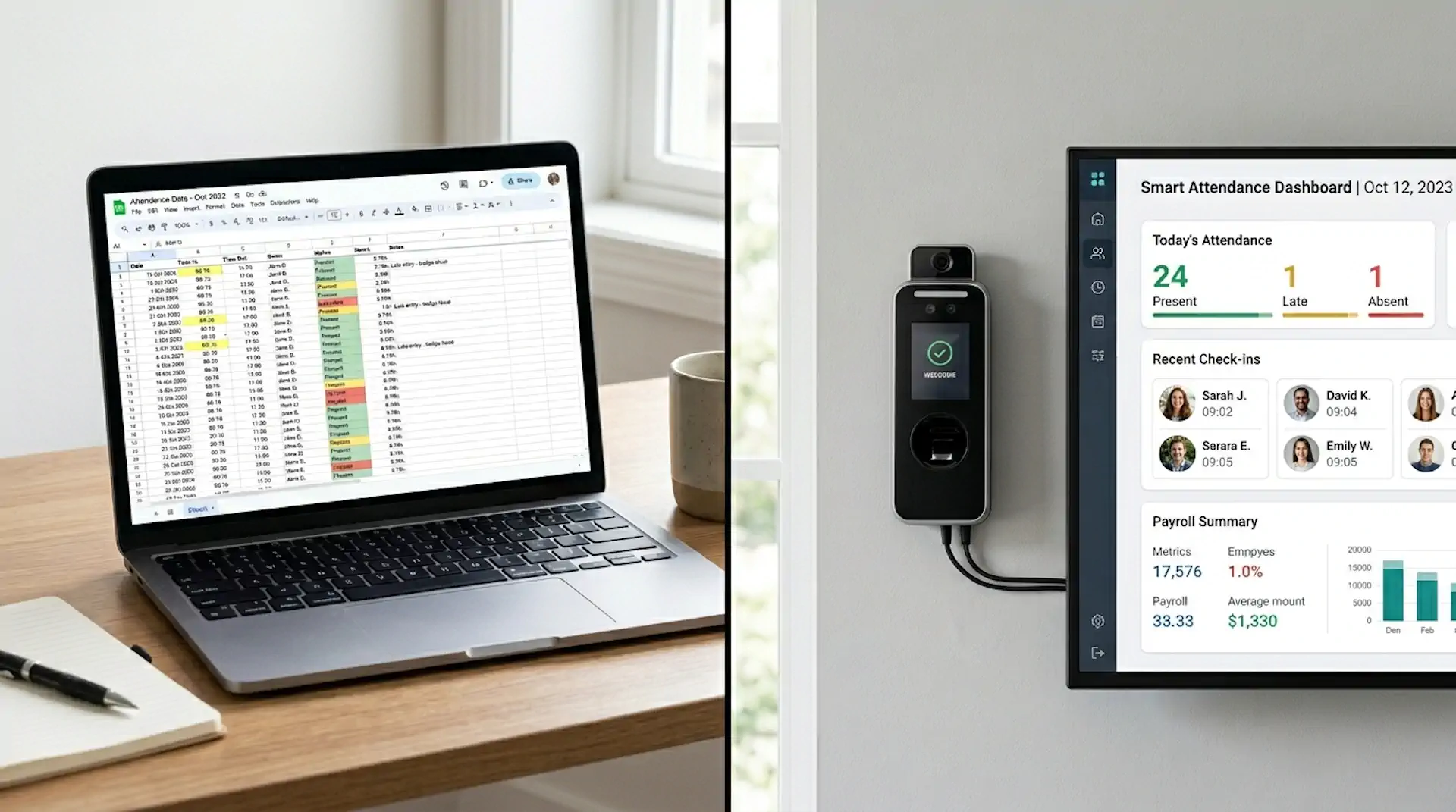
At a Glance
- Replaced a manual Google Sheets attendance process with a fully automated biometric system
- Zero manual entry — facial scan triggers check-in, break, and clock-out classification automatically
- Complete employee self-service portal — leave requests, complaints, attendance records, and payment visibility in one place
- Automated payroll reporting — overtime, rates, and period-based calculations generated on demand
- Mistaken scan handling — built-in correction logic prevents false records from corrupting payroll data
The Challenge
High Quality Motor Service was managing workforce attendance the way most growing SMEs do — with a shared Google Sheet and a person responsible for keeping it accurate. For a multi-shift warehouse operation manufacturing and distributing heavy-duty industrial engine parts, that approach had become a serious liability.
The problems weren’t occasional. They were structural:
Google Sheets is not an HR system. There was no reliable way to distinguish a check-in from a clock-out, log a break, or flag an unusual scan. Every edge case — an employee who forgot to log in, a scan at the wrong time, a missed break record — required manual intervention and judgment from whoever was maintaining the sheet.
Accuracy was impossible to guarantee. Payroll calculations were built on top of data that nobody fully trusted. Disputes were common, reconciliation was slow, and the person responsible for the sheet was spending hours every pay period doing work that should not require human hands.
There was no visibility for employees. Workers had no way to check their own records, request time off formally, raise a concern, or see whether their payment had been processed. All of that happened through informal channels — messages, phone calls, conversations — with no audit trail and no accountability.
The hardware existed but was disconnected. The Anviz FacePass7 Pro facial recognition device was already on the floor. Employees were scanning their faces. That data was going nowhere useful.
The Approach
The right solution here was not a SaaS HR product. Off-the-shelf HR platforms are built for generic organizational structures and come with years of features the client would never use, at a recurring cost that doesn’t make sense for an operation of this size.
The right solution was a purpose-built platform — engineered specifically around how this workforce operates, connected directly to the hardware already in place, and owned entirely by the client with no subscription dependency.
I designed the full system architecture before writing a line of code: the data model for employees, shifts, scan events, leave requests, complaints, and payment records; the logic for classifying scan types and handling edge cases; the permission structure separating employee-facing views from management dashboards; and the integration layer connecting the Anviz device to the platform via the CrossChex API.
WordPress with ACF Pro was the right foundation — it gave me complete control over the data schema, the user role system, and the front-end interfaces without the overhead of building a framework from scratch.
What I Built
Biometric Hardware Integration Connected the Anviz FacePass7 Pro directly to the platform via the CrossChex API. Every facial scan — whether clock-in, break start, break end, or clock-out — triggers an immediate event push to the system. The platform classifies the scan type automatically based on sequence logic, so employees don’t need to select what kind of scan they’re performing. It just knows.
Mistaken Scan Correction Logic Built handling for the edge cases that break every basic attendance system. If an employee scans at the wrong time or in the wrong sequence, the system flags the anomaly rather than silently recording bad data. Corrections can be applied by management with a full audit trail, so payroll is never built on unresolved errors.
Automated Payroll Reporting Engine The system calculates attendance, worked hours, break deductions, and overtime automatically against each employee’s assigned shift schedule. Management can generate a payroll-ready report for any date range on demand — daily, weekly, monthly, or custom. The calculations that previously required hours of manual spreadsheet work now take seconds.
Employee Self-Service Portal Each employee has a personal account with access to their own attendance records, worked hours, and break logs. From their portal they can submit leave requests and time-off applications, raise complaints or concerns through a formal internal channel, and check their payment status once payroll has been processed — all without needing to contact HR directly.
Management Dashboard A separate admin interface giving management full visibility across the workforce: real-time attendance status, pending leave requests, open complaints, overtime summaries, and full historical records per employee. Everything that used to exist across fragmented spreadsheets and informal conversations now lives in one place.
The Outcome
The Google Sheet was retired on day one of go-live and has not been touched since.
The employee responsible for manually maintaining attendance records shifted their time to work that actually requires human judgment. Payroll calculations that previously took hours to compile now generate in seconds with data that is accurate by construction — not by verification.
For employees, the shift was equally significant. For the first time, every worker had visibility into their own records, a formal channel for requests and concerns, and confirmation when their payment had been processed. The informal back-and-forth that used to handle all of this simply stopped.
What was replaced here wasn’t just a bad process. It was an entire informal operating layer — the conversations, the manual checks, the disputes, the chasing — that the business had built up around the absence of proper infrastructure. That layer is gone. The platform replaced it entirely.
My Role & Responsibilities
I owned this project from requirements gathering through architecture, build, integration, and deployment. I mapped the full data schema, designed the employee and management interfaces, built the CrossChex API integration, engineered the scan classification and correction logic, and delivered the complete system including staff onboarding. This was a solo engagement — no development team.